- FOUNDATION
- |
- IPPE
- |
- PPFC
- |
- CONTACT
News Release
- Media Center Home /
- News Release View


For Immediate Release
U.S. Poultry & Egg Association
Tucker, Ga. - April 14, 2026
- Contact:
- Hannah Keck, 678.514.1979, hkeck@uspoultry.org, (USPOULTRY)
New Research Sheds Light on Egg Drop Syndrome Transmission and Vaccination Response
USPOULTRY and the USPOULTRY Foundation announce the completion of a research project evaluating the spread of Egg Drop Syndrome 1976 (EDS 76) and flock responses to vaccination. The research is part of the Association’s comprehensive research program, which encompasses all phases of poultry and egg production and processing, and is made possible in part through proceeds from the International Poultry Expo, part of the International Production & Processing Expo.
F-111: Virus Isolation, Serological Surveillance and Mechanical Transmission of Egg Drop Syndrome
Once considered exotic to the United States, EDS 76 — caused by duck Atadenovirus A — reemerged in 2018, affecting commercial layer and broiler breeder flocks and resulting in reduced egg production and soft- or shell-less eggs.
Researchers at the University of Georgia recently completed a study examining how the virus spreads, how flocks respond to vaccination, and the effectiveness of cleaning and disinfection practices. The study had three primary objectives: to determine which cell lines can support virus isolation from field and environmental samples, including evaluating cleaning and disinfection efficacy; to assess antibody responses and viral shedding in vaccinated and unvaccinated flocks on farms with and without EDS 76; and to investigate potential transmission routes, including insects and other environmental sources.
Results showed that while virus detection in field samples remains challenging, viral DNA was identified on eggs, egg cartons, insects and live market ducks, highlighting potential pathways for transmission. These findings underscore the importance of robust biosecurity, environmental monitoring and vaccination strategies in managing this reemerging poultry disease.
The research summary can be found on the USPOULTRY website. Information on other Association research may also be obtained by visiting the USPOULTRY website.
###
More Recent News
May 26, 2026
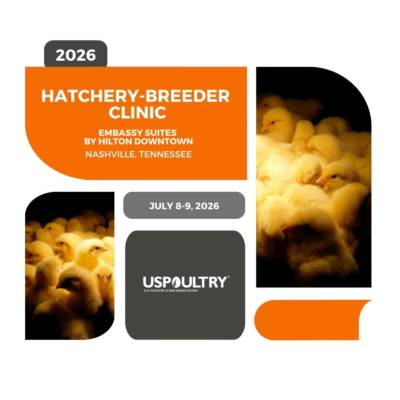
USPOULTRY to Host 2026 Hatchery-Breeder Clinic Focused on Innovation, Operational Excellence and Flock Performance
USPOULTRY will host its 2026 Hatchery-Breeder Clinic from July 8-9 in Nashville, Tenn. The annual clinic will bring together hatchery and breeder managers and other industry professionals to...
May 12, 2026
USPOULTRY Workforce Success and Engagement Conference Focuses on Leadership, Communication and Employee Engagement
USPOULTRY recently held its 2026 Workforce Success and Engagement Conference, bringing together human resources (HR) professionals, operations leaders and industry experts to discuss the evolving...

May 11, 2026
Development of U.S.-Strain Live and Inactivated Vaccines for Control of Avian Metapneumovirus Subtype B in Poultry
USPOULTRY and the USPOULTRY Foundation announce the completion of a research project that developed both live and inactivated vaccine candidates for avian metapneumovirus (aMPV) subtype B. T...

Contact Information
1530 Cooledge Road
Tucker, GA 30084-7303
Tel: 770.493.9401
Fax: 770.493.9257
General Info
Events & Meetings
People & Groups
- Affiliated States
- Air Cargo Committee
- Hen Council
- Industry Partners
- Poultry Protein & Fat Council
- USPOULTRY Foundation